Full Color_Light
Full Color_Light

FREE RESEARCH GUIDE: Build a Messaging Strategy That Wins in 2026

FREE GUIDE: Build a Messaging Strategy That Wins in 2026

Successful campaigns and advocacy programs test early, gain the persuasion advantage, and start scaling before voters tune in. This guide gives you:
  • A full campaign research timeline — what to test in the early, mid, and late cycle
  • The key questions top campaigns ask to understand audiences and identify persuasion opportunities
  • How to run audience surveys and message tests that reveal what actually moves people

Inside this guide, you'll find:

  • A full campaign research timeline
  • The key questions top campaigns ask to understand audiences and identify persuasion opportunities
  • How to run audience surveys and message tests that reveal what actually moves people
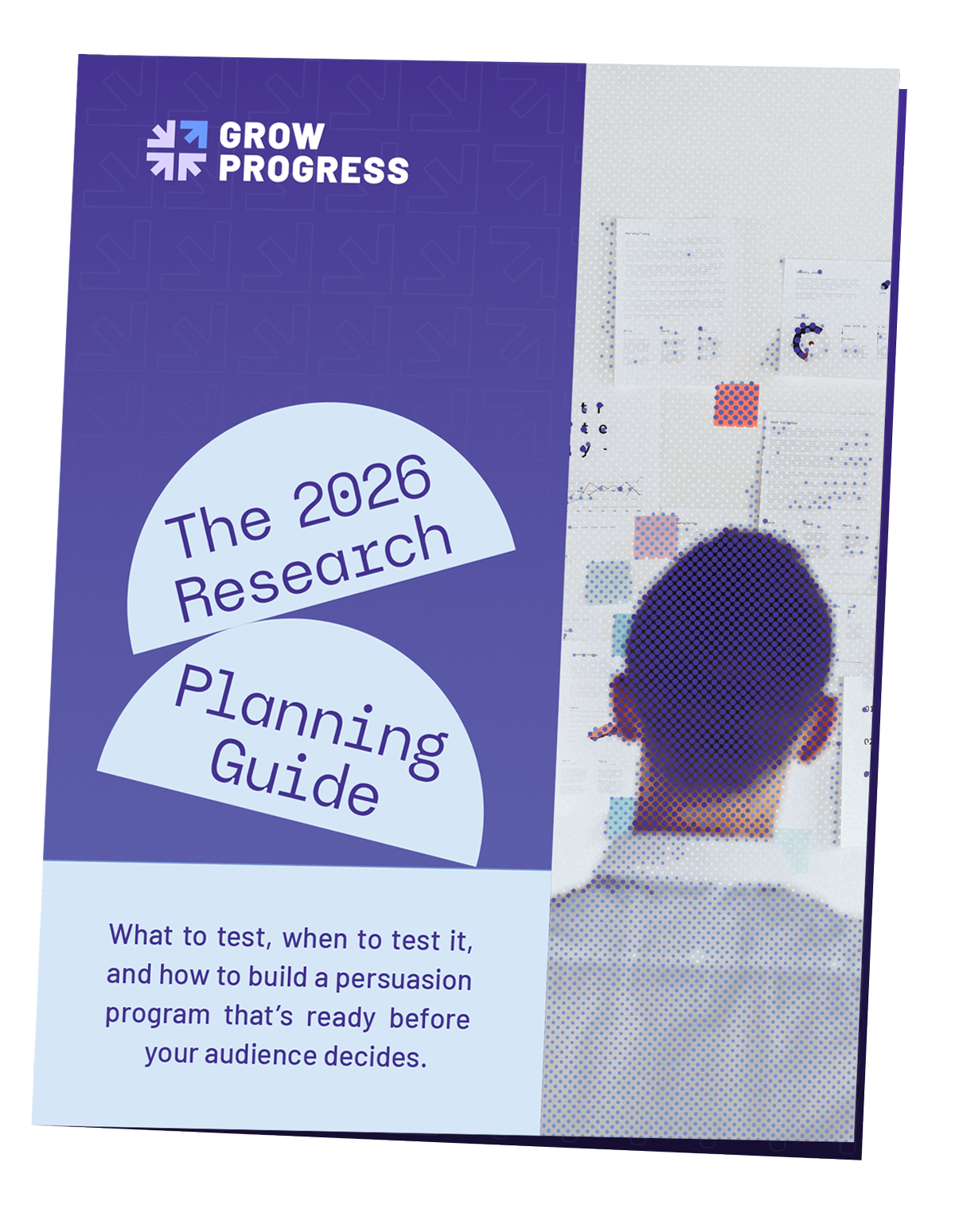
Research Planning Guide Preview Image

TRUSTED BY:

Lyft-Logo-768x512
Texas-Democrats-v4
Galvanize-Action
NEA-jpg
New-Media-Firm-1-535x115
Giffords
Global-Strategy-Group
Reproductive-Freedom-for-All-1
Berlin-Rosen
Precision
SEIU
Progress-Now

Built for the Teams Responsible for Winning

Research and Insights Leaders

Turn testing into a strategic roadmap and demonstrate measurable ROI to donors, executives, and boards.


Digital and Media Teams

Optimize persuasion before major spend, improve targeting, and scale creative that’s proven to move people.

Communications and Campaign Leadership

Align strategy, narrative, and investment around evidence that holds up under real-world pressure.

Message testing, audience insight, and persuasion strategy only work when there’s time to act on what you learn.

Teams that start early can:
  • Identify the audiences that will decide close races
  • Prove impact to donors and leadership before major spend
  • Refine persuasive messaging before opposition narratives lock in
  • Enter the paid media window with confidence

Late starters don't just lose time. They lose leverage.

hourglass icon

Your Month-by-Month Testing Plan for the 2026 Cycle

This practical research planning guide maps the entire election cycle—from early strategy to late persuasion—showing what to test, when to test it, and how leading campaigns operationalize insight.

arrows pointing inward
Early Cycle (Feb-Apr)

Set Strategy With Real Audience Insight

Define success, clarify your theory of change, identify target audiences, and launch audience understanding and early message exploration before the landscape hardens.

geo location icon
Mid-Cycle (May-Aug)

Refine What Actually Persuades

Dial in the messages, values, and narratives that move the people you need in your base—while pressure-testing opposition arguments or rapid response moments, and optimizing creative before peak spend.

sliders for fine tuning
Late Cycle (Sep-Oct)

Enter the Final Stretch, Miles Ahead

Scale the highest-performing messaging, validate late-breaking shifts, and move into this critical cycle with confidence grounded in evidence, not just instinct.
Powered by the Same Testing Used in Real Campaigns

The research planning guide is grounded in the proven methodology behind Grow Progress—combining audience understanding, rapid message testing, opposition testing, tracking surveys, and real-world experimentation to help campaigns move faster and persuade more effectively.

Use it on your own.

Or partner with us to execute it with speed and rigor.

cover_mock_with-padding
calendar graphic

Q1 Decisions Shape Q4 Outcomes

By summer, the campaigns that started early will already know: 

  • Who they must persuade
  • What messages win
  • How to spend with confidence

Everyone else will still be guessing.

Start your testing plan now - while there’s still time to change the outcome.
Full Color_Light 1